


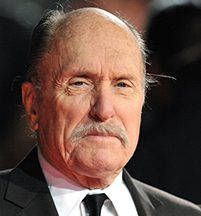
In Memoriam: Robert Duvall
Robert Duvall (1931-2026) had a career of 60-plus years that saw him working with several generations of top talent. He won four Golden Globes, out of seven nominations, for a combination of his film and TV work.
Duvall also had a classic actor’s trajectory in the mid-20th century: He started making stage appearances in New York (including A View From the Bridge, for which he won an Obie award in 1965), and segued to three dozen TV series. Among his TV credits were Naked City, The Untouchables, Twilight Zone, The Outer Limits, and The Fugitive.
In Hollywood, he had a small but memorable role as Boo Radley in To Kill a Mockingbird (1962), scripted by Horton Foote, with whom he had worked on the New York stage. After that, Duvall spent several years alternating between leading roles and, more frequently, supporting major stars, including Marlon Brando, Jane Fonda and Robert Redford in The Chase (1966); Steve McQueen in Bullitt (1968); Frank Sinatra in The Detective (1968); John Wayne in True Grit (1969); and Clint Eastwood in Joe Kidd (1972).
Meanwhile, three key directors cast him in leading roles: Robert Altman with Countdown (1967), where he worked with frequent costar James Caan, and Altman’s huge hit MASH (1970). Francis Coppola cast him in The Rain People (1969). Meanwhile, George Lucas also put Duvall front and center with the dystopian THX1138 (1971). But it was the following year when Duvall was really put on the map with the Coppola-directed The Godfather. Duvall repeated the role of mob-family attorney Tom Hagen in The Godfather Part II (1974).
The actor parlayed his success into multiple other roles, and was never insistent on playing the lead. He continued to balance lead and supporting roles and never seemed to be out of work. He returned to TV for the title role in the 1979 miniseries Ike: The War Years; that same year, he starred as Bull Meechum in The Great Santini as a cold and demanding father.
The year after winning a Golden Globe (and Oscar) for Tender Mercies (1983), he again was supporting the star, in this case Robert Redford in The Natural.
Duvall’s multiple roles showed his intensity and distinctive, clipped delivery. But he was able to tap into his softer side for works like the miniseries Lonesome Dove (1989), based on Larry McMurtry’s novel. He also had presence and seemed like he could take control of any situation — which made his characters either reassuring or scary, sometimes both.
The term “an actor’s actor” is overused, but in some cases it’s true. Duvall was admired by fans, but usually revered by others in the industry; in this way, he’s similar to Gene Hackman, a friend from their early days as struggling thesps.
Though friends often remarked on how funny he was, Duvall rarely got an outright comedic role. And while he was a longtime tango aficionado, he rarely got to show his physical grace in films. Some of his unusual roles include The Seven Percent Solution (1976), playing Dr. Watson to Nicol Williamson’s Sherlock Holmes. And one of his best roles was in The Judge (2014), starring Robert Downey Jr.
He certainly entered movie immortality in Coppola’s Apocalypse Now (1979) in which Duvall’s Lt. Colonel Kilgore delivered the classic line, “I love the smell of napalm in the morning.”
He has nearly 150 film and TV credits. A list of his coworkers gives an indication of the length and breadth of his career. A fraction of those names: Nicolas Cage, Michael Caine, Glenn Close, Tom Cruise, Robert De Niro, Laura Dern, Farrah Fawcett, James Gray, Richard Harris, Ron Howard, Burt Lancaster, Mimi Leder, Shirley MacLaine, Demi Moore, Viggo Mortensen, Laurence Olivier, Ivan Passer, Sam Peckinpah, Arthur Penn, Joaquin Phoenix, Vanessa Redgrave, Jason Reitman, Billy Bob Thornton, Denzel Washington, and Steven Zaillian.
His final screen appearance was in the under-rated The Pale Blue Eye (2022), directed by Scott Cooper who had earlier worked with him on Crazy Heart (2009).
Some of the actor’s favorites works were Tomorrow (1972), a small-scale drama cowritten by Foote; and The Apostle (1997), one of the five films he directed.
Early in his career, Duvall starred in 1962 episode of TV’s Alfred Hitchcock Presents, titled Bad Actor. That was undoubtedly the only time that the phrase was attached to Robert Duvall.