


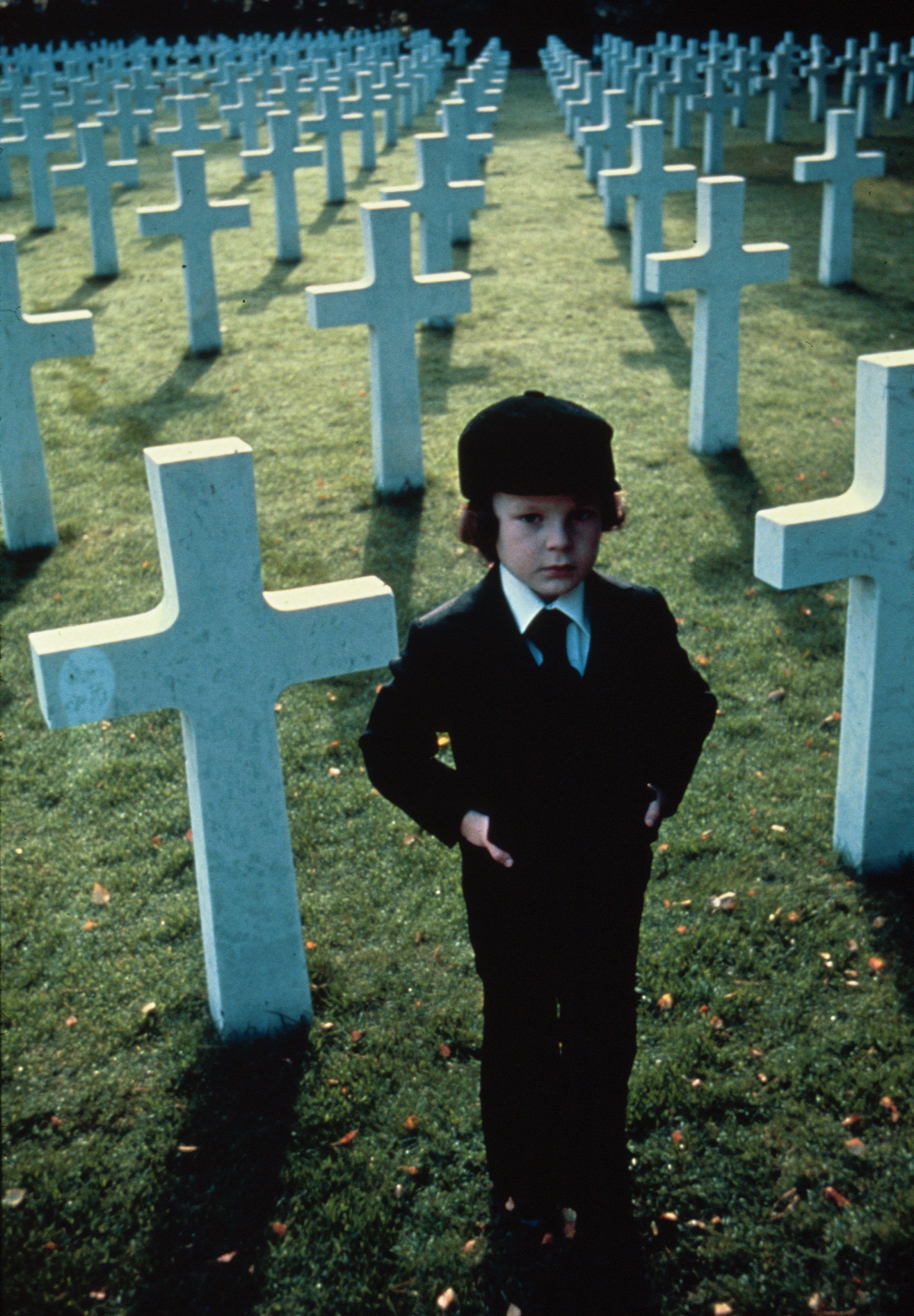
‘The Omen’ at 50: The Timely Horror of Politics & Instability
June 25, 2026, marks the 50th anniversary of Fox’s The Omen, which earned a huge $60 million in its initial run and spawned years of sequels, TV series, a remake and endless ripoffs. The original film’s endurance means it struck a long-lasting, universal chord, though it also was a product of its time and place.
By the late 1960s and early 1970s, the United States had entered a period defined by exhaustion. The confidence of postwar America was beginning to erode under the pressure of Vietnam, Watergate, economic recession, and a growing distrust toward political institutions, in a decade haunted by assassination and political trauma. Horror films reflected the change.
Earlier decades had imagined evil as something external — monsters, aliens, supernatural creatures. But 1970s horror moved inward. Fear settled into homes, families, and familiar spaces. Rosemary’s Baby (1968) and The Exorcist (1973) were among the clearest expressions of this shift.
The Omen (1976) pushed this tendency even further by connecting supernatural dread to political power. The film was written by David Seltzer, produced by Harvey Bernhard and directed by Richard Donner.
It follows Robert Thorn (Gregory Peck), an American diplomat who slowly realizes that his adopted son Damien may be the Antichrist. What makes the premise unsettling is not simply its religious dimension, but the setting: embassies, state ceremonies, official institutions, carefully ordered lives. The apocalypse no longer feels distant or mythical. It appears embedded within the structure of modern authority.
That idea resonated strongly in post-Watergate America. By the mid-1970s, institutional trust had deteriorated to the point where paranoia no longer seemed irrational. In The Omen, Thorn begins as a man of composure and certainty. He believes in systems and rational explanations. Watching those assumptions gradually collapse becomes the emotional center of the film. In many ways, Thorn’s journey mirrors the psychological movement of the decade itself: the uneasy transition from confidence to suspicion.
Part of what gave The Omen its unusual power was the seriousness with which it approached its material. Producer Bernhard later recalled that the project originated from conversations about what the birth of the Antichrist might look like in the contemporary world. Screenwriter Seltzer built the story around that. In another director’s hands, the film might have become lurid exploitation — another sensational occult thriller designed around shock value and satanic imagery. Donner turned it into something far more restrained.
Most of Donner’s background was in television, directing episodes of several dozen series such as The Twilight Zone and Kojak. Television demanded economy, pacing, and careful control of tension. Donner understood how to sustain atmosphere without constantly pushing toward spectacle. While many horror films of the era relied on graphic violence, The Omen’s fear arrives gradually. Early on, the film feels quiet, almost procedural, as if terror is slipping unnoticed into ordinary life.
That restraint gives the film much of its lasting effectiveness. Even the film’s most famous deaths are staged with remarkable control. Donner allows tension to accumulate slowly, which makes the violence feel sudden and disturbingly matter-of-fact when it finally erupts.
Casting Peck was essential to achieving this tone. Peck has the moral authority of classical Hollywood — dignity, rationality, and integrity. Audiences trusted him almost instinctively. That trust becomes crucial to the film because The Omen depends less on spectacle than on watching certainty gradually disappear from Peck’s face. Robert Thorn does not collapse dramatically; he erodes.
Seen now, 50 years later, The Omen feels less like a film obsessed with Satanic imagery than a film obsessed with instability. What frightened audiences in 1976 was not simply the possibility of evil, but the growing suspicion that the structures meant to provide order — family, religion, politics — no longer felt secure. The horror comes from the realization that modern life may not be as rational or controllable as it pretends to be.
The film changed Donner’s career. Hollywood suddenly saw him as a director capable of handling large-scale studio projects with unusual tonal control, which paid off with such classics as The Goonies (1985), and four Lethal Weapon movies, starting in 1987. Two years after The Omen, producers began searching for a director for Superman. Donner had demonstrated an ability to treat extraordinary material with emotional sincerity rather than irony. That quality was exactly what Superman needed.
The connection between The Omen and Superman feels less strange than it initially appears. One film captures a culture losing faith in its institutions; the other attempts to recover some moral clarity. Donner’s Superman was not cynical, tortured, or emotionally detached; Christopher Reeve’s performance emphasized decency, sincerity, and optimism. In a post-Vietnam America still marked by distrust and fatigue, those qualities mattered.
Seen together, The Omen and Superman almost feel like emotional opposites. One is consumed by anxiety; the other searches for reassurance. Yet both reveal the same filmmaker: someone interested in belief itself — how societies lose it, and how they attempt to rebuild it again.