


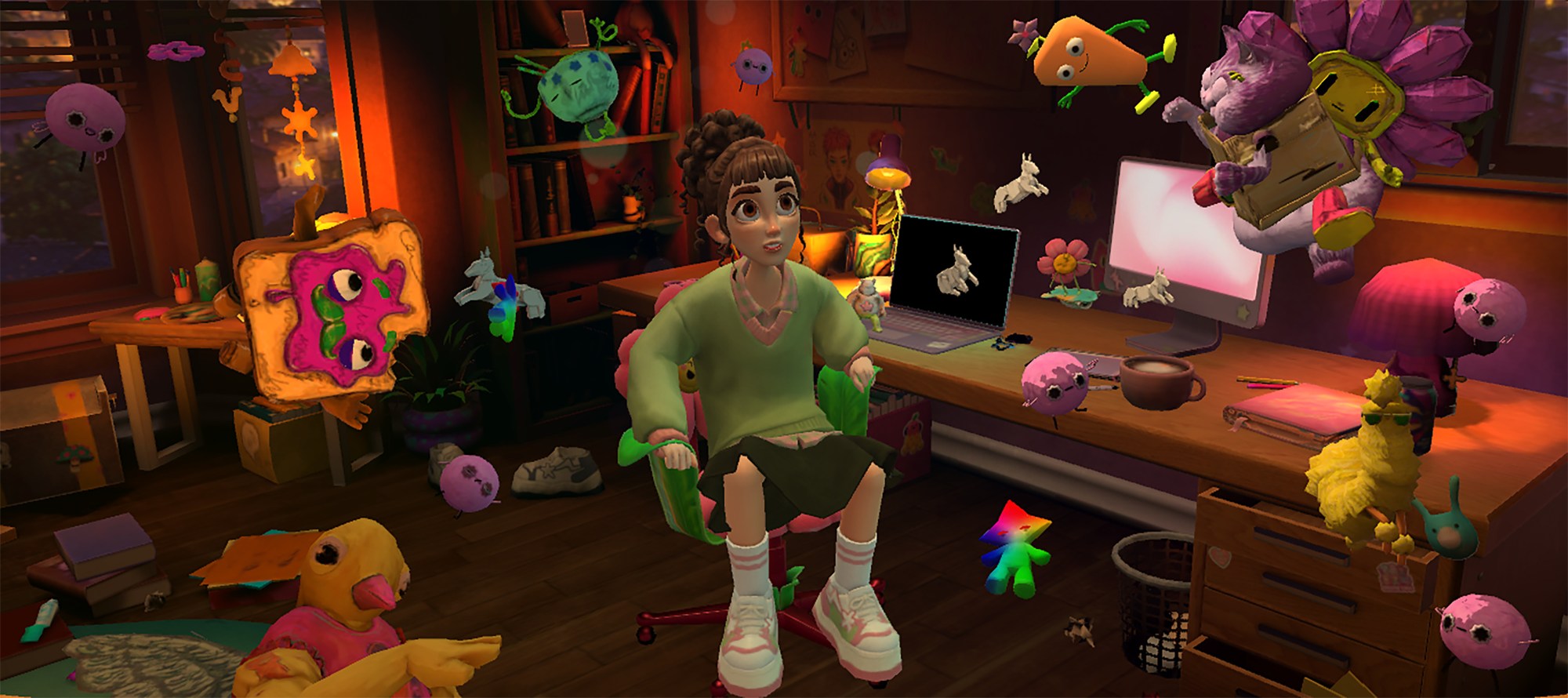
Venice Immersive Event Puts the Viewer in the Middle of the Action
For a century, cinema has asked audiences to sit still and look. Venice Immersive is asking what happens when the audience no longer looks at the story, but enters it.
Celebrating its 10th anniversary, Venice Immersive returns to the Venice Immersive Island on the Lazzaretto Vecchio September 2-12, during the 83rd Venice International Film Festival. The section presents 68 projects from 26 countries, including 30 works in competition, 35 projects in the Best of Immersive selection and three projects developed through Biennale College Cinema – Immersive.
Ten years after Venice created a dedicated space for virtual reality, the technology itself is no longer the main part of the story. The more interesting development is what artists are doing with it.
“Immersive” has become a fashionable word in entertainment, applied to everything from giant screens and elaborate sound systems to theme-park attractions. But immersive storytelling is something more fundamental: It changes the relationship between the audience and the image.
Traditional cinema controls the viewer’s gaze. The frame determines what can be seen, the edit determines when it can be seen, and the director ultimately controls the point of view. Immersive work can surrender part of that control.
The viewer can move through a space, inhabit an avatar, encounter other participants, interact with a virtual environment or simply experience the sensation of being physically inside a story rather than watching it from the outside.
As Venice Immersive curator Michel Reilhac puts it: “When I go to the cinema today to see a flat film, I am frustrated. I miss the rest. I ask myself: where is the rest? Why am I seeing only a rectangle, a portion of the world?”
That question has been at the heart of Venice Immersive since its beginnings.
Venice was among the first major festivals to recognize that virtual reality might represent more than a technological curiosity. A VR Theatre was introduced in 2016; in 2017, La Biennale di Venezia launched the first official competition for VR works within an A-list film festival. After two online editions during the pandemic, Venice Immersive returned to the Lazzaretto Vecchio in 2022 under its current name.
What began with headsets and 360-degree video has expanded into virtual and mixed reality, immersive installations, virtual worlds and XR experiences designed for a new generation of glasses.
The shift is also philosophical.
“When we started, people were fascinated by what the technology could do,” Reilhac has said. “Now the technology is becoming more and more a tool to express feelings, emotions and human qualities.”
That may be the clearest indication that immersive storytelling is maturing. The technology is becoming less visible as the storytelling becomes more ambitious.
This year’s Venice selection makes that transformation particularly visible because the immersive universe is increasingly attracting the names that populate Hollywood’s recognizable productions.
Apple Vision Pro has helped move immersive storytelling into the broader entertainment conversation, while Apple’s Immersive Video slate has expanded to include productions involving major global publishers, broadcasters, studios and brands such as BBC, CNN, Canal+, Hybe, MotoGP and Red Bull. Some newer productions have been among the first captured with Blackmagic Design’s URSA Cine Immersive camera, indicating that immersive production is also beginning to develop its own production infrastructure.
The shift is no longer confined to experimental studios or technology companies: increasingly, established filmmakers are treating immersive media as another branch of cinematic language.
Edward Berger’s Submerged and Doug Liman’s Asteroid premiered in Venice Immersive in 2025, providing an early indication that filmmakers from the mainstream feature-film world were willing to experiment with the medium.
The message is clear: Venice is no longer simply presenting the future of storytelling. It is becoming one of the places where established filmmakers can test that future.
The most conspicuous example in this year’s selection is Nevatars, directed by actor-filmmaker Andy Serkis and Josh Nelson Youssef. It is produced by Imaginarium Productions, Boona, Google – 100 Zeros and 3Dar.
The project is experienced through XR glasses, pointing toward a future in which immersive storytelling may no longer require audiences to retreat into a separate virtual environment.
There is also Galapagos: The Last Eden, directed by Anthony Geffen and featuring Margot Robbie, which uses XR glasses to transform the natural-history documentary into a spatial experience.
Mark Ruffalo lends his presence to Solwata, while Isabelle Huppert provides the voice for Gordon’s Outrenoir. Omar Sy is part of the cast of Abderrahmane Sissako’s Artou.
And then there is Bowie: Unseen Unheard, an immersive audiovisual installation directed by Denis O’Regan, Nick Ryan and Joe Crossley, built around the photographic archive of David Bowie by O’Regan. It offers another bridge between established popular culture and emerging forms of spatial storytelling.
These projects suggest that immersive media is no longer an isolated laboratory operating on the margins of entertainment.
Hollywood is beginning to look at it as another place where stories, characters and cultural worlds can live. But Venice Immersive is careful not to turn the medium into an extension of Hollywood IP. That may be what makes the section interesting.
Alongside internationally recognizable performers are artists working at the intersection of contemporary art, gaming, performance, documentary and experimental cinema. The result is less a new genre than a new ecosystem.
For co-curator Liz Rosenthal, the most important development is not technological: It is the convergence of disciplines.
“We are inside a film festival, but we curate works that bring together many different art forms,” Rosenthal has explained. “We see performers, musicians, filmmakers, game designers and artists who are native to new spatial and embodied experiences.”
That concept — embodiment — may be the key to understanding where immersive storytelling is going. The body, rather than simply the eye, becomes part of the narrative.
An audience member can walk through an installation, encounter another participant, change perspective, inhabit a digital body or experience a story from within a virtual environment.
If cinema helped teach generations of audiences how to look at the world through a frame, immersive media may teach them to think about identity, space and presence differently.
In virtual environments, identity itself can become fluid. For Reilhac, that makes immersive storytelling closer in some ways to performance, choreography and body art than to traditional filmmaking.
“In an immersive experience you can experiment with what it means to be somebody else or something else, with another body,” he has said.
There is an apparent paradox at the center of the medium’s development. The more sophisticated immersive technology becomes, the less important it should feel. The goal is for audiences to leave an experience forgetting they are wearing the headset.
Rather than relying on technological spectacle, the installation Nothing to See Here, by Celine Daemen, plays with perception, questioning where the viewer is looking from and what constitutes reality.
The next major transformation may come not from better headsets, but from smart glasses.
For years, the immersive industry has imagined a future in which VR becomes lighter, more accessible and more integrated into everyday life. The 2026 Venice selection suggests that the next chapter may finally be taking shape.
Nevatars and Galapagos: The Last Eden are designed for XR glasses, pointing toward an experience in which virtual and physical environments coexist rather than requiring audiences to disappear completely into a headset. That could change not only storytelling, but distribution.
Today, an immersive work generally requires a dedicated space. Tomorrow, that space could be the world around us.
Location-based immersive entertainment is already developing into a commercial sector, while the industry continues to search for the equivalent of a streaming platform for individual immersive experiences.
At the same time, the production ecosystem is beginning to mature: Apple’s expanded Immersive Video slate, for example, now connects immersive filmmaking with broadcasters, sports rights-holders, music companies and global brands, while new cameras and post-production tools are being developed specifically for spatial video.
Festivals can provide visibility. Museums can provide exhibition space. Dedicated venues can provide audiences. But the medium’s long-term future may depend on whether immersive storytelling can eventually reach viewers as easily as a film reaches them through a television or smartphone.
When Venice first presented VR, the obvious question was whether this new technology could become cinema’s future. Ten years later, that question feels almost outdated.
Venice Immersive is not trying to replace cinema, but rather demonstrating that cinema is no longer the only model available for audiovisual storytelling.
“What happened during these ten years was not simply the birth of a new language or a new art form,” Reilhac says. “It was the possibility for a technology to become a tool to access emotions, feelings and shared ideas. Today technology is no longer the main fascination: it is used to express something deeply human.”
Rosenthal sees the transformation in similarly historical terms: a moment when forms that were once kept apart — cinema, gaming, performance, music, visual art and digital worlds — are beginning to merge.
That may ultimately be the real significance of Venice Immersive’s first decade — that the old boundary between watching a story and entering one is slowly disappearing.