


- Golden Globe Awards
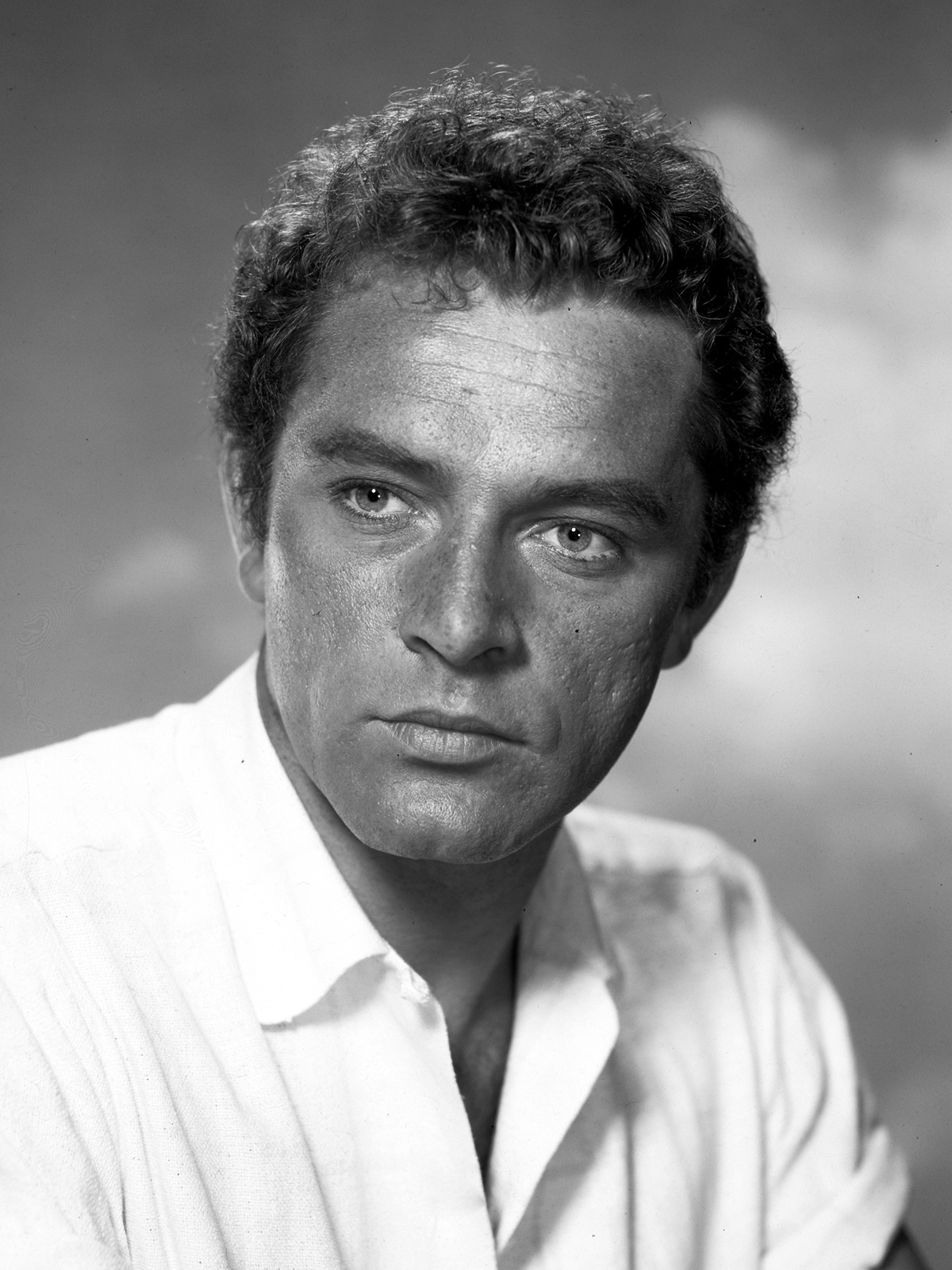
Tomorrow’s Stars Yesterday: Richard Burton, 1953
Between 1948 and 1983 Golden Globes were awarded in a special category of “New Star of the Year” to recognize actors making a mark in their early roles. In this series, the HFPA’s Phil Berk highlights those that would follow their auspicious starts with distinguished careers.
Richard Burton might never have won the Cecil B. DeMille award, but he was certainly one of the greatest stars of the last century. Someone once claimed Fred Astaire gave Ginger Rogers class and Rogers gave him sex appeal. Similarly, you might say of that other Hollywood paring, that Richard Burton gave Liz Taylor class, and she gave him sex appeal in return. One of the enduring partnerships of cinema, Burton and Taylor were for many years inseparable – unfortunately, all good things inevitably come to an end in Hollywood, but sometimes not before a few sequels.
Burton always acknowledged that Taylor taught him how to act in front of a camera. Even though he was named New Star of the Year in 1953, he had established himself as the most promising actor on the London stage years before Twentieth Century Fox “discovered” him and signed him to a long-term contract. His first assignment was a co-starring role opposite Olivia de Havilland in Henry Koster’s adaptation of Daphne du Maurier’s My Cousin Rachel.
Burton, however, had earlier appeared impressively in his Welsh idol Emlyn Williams’ Last Days of Dolwyn but had been overshadowed by stage actress Edith Evans, whose towering debut performance, at the age of 60, encouraged a movie career. His second role under his new contract in Fox’s first CinemaScope mega release The Robe established him as the industry’s newest asset, a pretty face idealized by bobbysoxers and a Shakespearean talent admired by more mature audiences. He soon became stuck in this Hollywood quagmire, was cast in successive Cinemascope spectaculars, until finally getting a huge boost when he was cast as Marc Antony in Taylor’s blockbuster Cleopatra. Of course, the rest is history.
The two fell in love, even though they were both, carried on a tumultuous love affair, were front-page stories the world over, and inevitably tied the knot and for a time lived happily ever after.
With Taylor he made a number of high-profile films, at the same time carving out an impressive career on his own, during which time he was nominated for numerous Golden Globes and Oscars – never once a winner, mainly because he had the bad fortune of competing in very competitive years.
After The Robe he played Edwin Booth inPrince of Players, Lana Turner’s Indian paramour in The Rains of Ranchipur, Alexander the Great in Robert Rossen’s disappointing film bio, Joan Collins’ love interest in Sea Wife, and a commando in Nicholas Ray’s dour Bitter Victory. He sought refuge in England as Jimmy Porter in Tony Richardson’s Look Back in Anger, even though he was a little old to play that angry young man.
Back in Hollywood he appeared in Warner Bros.’ Ice Palace and The Bramble Bush and did a guest role for Fox in Zanuck’s The Longest Day, but his heyday seemed numbered until Joseph L. Mankiewicz cast him as Marc Antony, which changed the course of his life and career. After Cleopatra, he and Taylor made The V.I.P.’s a delightful Terence Rattigan-Anthony Asquith romantic drama which earned Margaret Rutherford, at age 71, a Golden Globe and an Oscar as Best Supporting Actress. The movie, no surprise, was a hit.
Now a box office draw, his alternating movies without Taylor established him as the screen’s most sought after leading actor. He played Becket opposite Peter O’Toole, which won the Golden Globe as Best Motion Picture; he was nominated but it was O’Toole who won. He played Rev. Dr. Shannon in Tennessee Williams’ The Night of the Iguana opposite Ava Gardner and Deborah Kerr; both the film and Gardner were nominated for a Golden Globe, but he wasn’t. He recreated his Broadway stage performance in Hamlet, and then as John le Carré’s reluctant spy in The Spy Who Came In From the Cold, arguably his strongest performance, he was nominated for an Oscar but, once again, didn’t win.
Back with Elizabeth Taylor, he was suave and desirable in Vincente Minnelli’sThe Sandpiper, though the film is best remembered for its Golden Globe-nominated song, “The Shadow of Your Smile”. Working again with Taylor, he was phenomenal in Mike Nichols’ classic Who’s Afraid of Virginia Woolf for which he would be Oscar and Golden Globe-nominated but would once again lose toA Man for All Seasons’ Paul Scofield.
He and Taylor teamed up for Zeffirelli’sThe Taming of the Shrew, which turned out to be a Shakespeare success, and it earned him another Golden Globe nomination. Another theater piece was Dr. Faustus which he also co-directed and, surprisingly, The Comedians based on a brilliant Graham Greene novel and screenplay failed to find critical and audience acceptance. Were they now losing their touch?
Certainly, their last collaboration Boom, despite a Tennessee Williams scenario and prestigious Joe Losey as director, didn’t help.
Burton continued to work frequently and was nominated for playing Henry VIII in Anne of the Thousand Days, but even though the film won the Golden Globe as Best Picture and Geneviève Bujold won as Best Actress, he was once again left empty-handed. For the next ten years, he appeared in successive films, none worthy of his stature, with the exception of Equus, which earned him his seventh and final Golden Globe nomination and his second win.
His published diaries, The Richard Burton Diaries, prove that he was not just a great actor but also a talented literary stylist.