


- Cecil B. DeMille
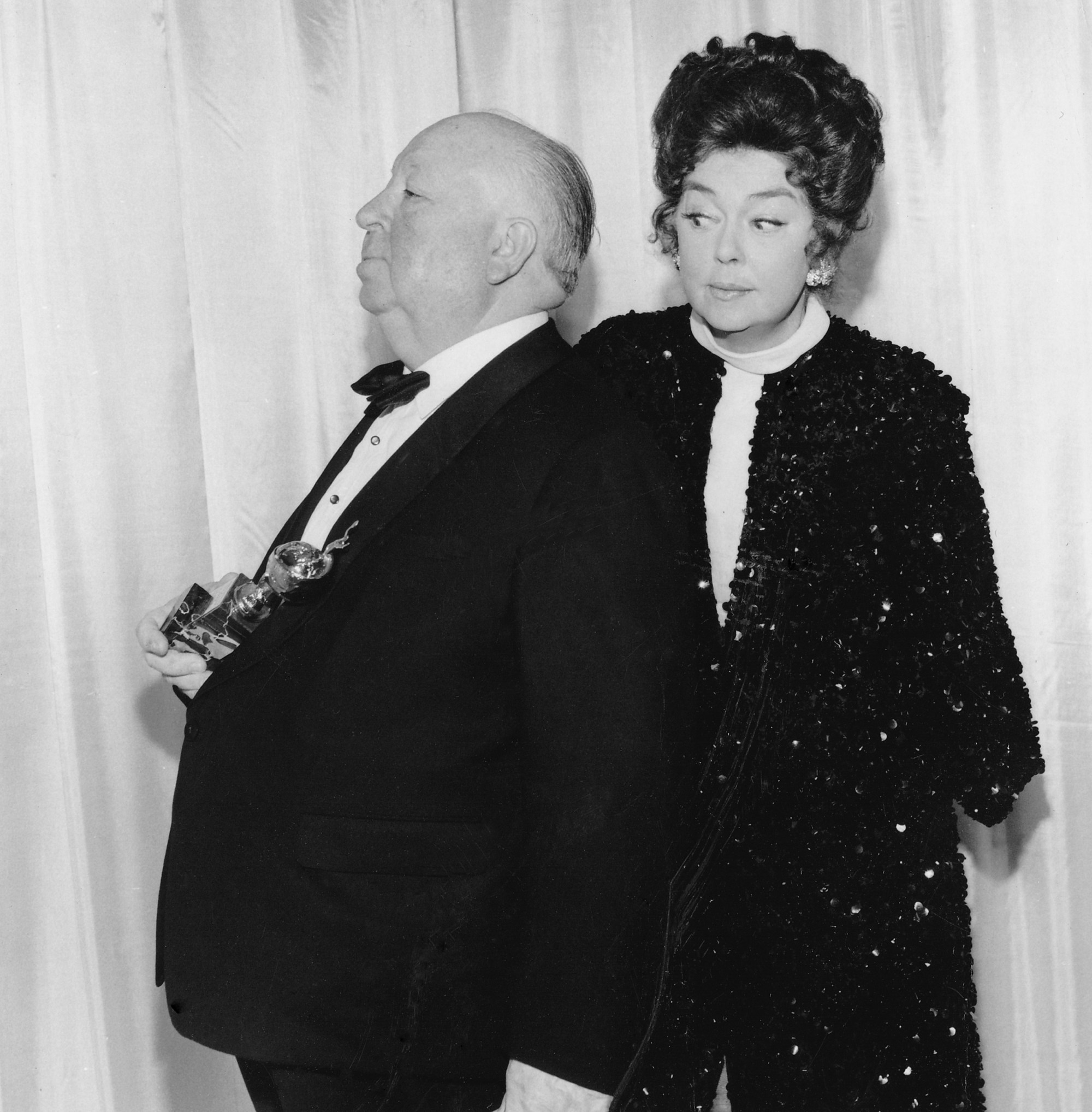
Ready for My DeMille: Profiles in Excellence – Alfred Hitchcock, 1972
Beginning in 1952 when the Cecil B. DeMille Award was presented to its namesake visionary director, the Golden Globes has awarded its most prestigious prize 66 times. From Walt Disney to Bette Davis, Elizabeth Taylor to Steven Spielberg and 62 others, the DeMille has gone to luminaries – actors, directors, producers – who have left an indelible mark on Hollywood. Sometimes mistaken with a career achievement award, per the Golden Globes statute, the DeMille is more precisely bestowed for “outstanding contributions to the world of entertainment”. In this series, former Globes president Philip Berk profiles DeMille laureates through the years.
Part One
No filmmaker in his time was afforded the adoration that was heaped on Cecil B. DeMille honoree Alfred Hitchcock. Besides the numerous biographies that have been written about him, he himself submitted to exhaustive interviews with directors Francois Truffaut and Peter Bogdanovich, which were recorded and later published, conversations in which he painstakingly dissected the over 50 feature films he made.
After an uneventful childhood in a middle-class English home, Hitchcock turned down a university education, which his family could well afford, to pursue an interest in advertising. He channeled his success in that field into his lifelong passion for movies and apprenticed himself to an upstart film company where he quickly rose from best boy to art director to screenwriter to director. His first film The Lodger signaled the arrival of a unique talent.
His subsequent silent films are not particularly cinematic, in fact, many of them were adaptations of successful plays, which contradicts his famous edict, “Movies are not photographs of people talking.” It was only after he signed with Michael Balcon (later responsible for those Ealing classics) that he earned his reputation as Master of Suspense. The Man Who Knew Too Much, The 39 Steps, Sabotage, and The Lady Vanishes, sealed his reputation as England’s greatest director, and it was only a matter of time before he ventured across the Atlantic and signed a contract with Hollywood’s greatest producer David O. Selznick.
Their first film together Rebecca, which was his only Oscar-winning film, was the first to attract an American audience. Of course, in England, he was always a box office draw, but in the U.S., he was known only to art-house audiences. Rebecca changed that. He remained in Hollywood for the next forty years, eventually becoming a US citizen, and, in his later years. a popular personality thanks to his weekly TV show Alfred Hitchcock Presents.
Yet it is mainly in Europe that his legacy is truly celebrated. His movie Vertigo was voted by Sight and Sound the greatest movie of all time, an accolade not universally endorsed, but then that has usually been the case throughout his career. Novelist Graham Greene, for one, believed he was grossly overrated, and to some, his English output doesn’t measure up to his American masterpieces. On the other hand, his early output in America, invariably given short shrift by critics, is today considered peerless classics: to wit, Notorious, Saboteur, Shadow of a Doubt, Lifeboat, Rope, yet none of them were Oscar or Golden Globe nominees.
Though British to the core, even during his greatest success in England, he always wanted to work in Hollywood, but relocating there would not be easy even though he was courted by Hollywood’s top producers including Walter Wanger and Samuel Goldwyn. He made a number of exploratory visits, the last at his own expense. Even though he valued his independence as a filmmaker he valued his worth much more and made sure his Hollywood salary should be commensurate with what he was paid in England, where he was always the highest-paid director.
Eventually, he signed with David O. Selznick, who at the time was preoccupied with Gone with the Wind, but that never prevented Selznick from giving himself the better end of the deal. His contract was engineered by his newly acquired American agent who just happened to be Selznick’s brother, Myron.
Despite his initial unease, a number of serendipitous things happened for him during the pre-production of Rebecca. Selznick wanted Hitchcock to “film the book,” as he had done with GWTW, a demand which was anathema to Hitch who rarely stayed faithful to the source. But then just as he was ready to give in to the implacable producer, the New York Film Critics awarded him their prize as Best Director, an honor that placated Selznick, and after that Hitchcock was given free rein. Even though, as he later told Truffaut, he never thought much of Rebecca, the film not only won the Best Picture Oscar but it made international stars of Laurence Olivier and Joan Fontaine, the latter incidentally Hitch’s second choice for the role, his first being the insipid leading lady from two of his worst films, Nova Pilbeam.
Hitchcock adopted an extravagant Hollywood lifestyle which included entertaining fellow expatriates and newly acquired Hollywood friends, weekly meals at Chasen’s, and the Cocoanut Grove. In order to pay for his extravagances, he needed to work in addition to the two films a year he was contracted to make for Selznick. The first of these was a screwball comedy, Mr. and Mrs. Smith, which he did as a favor for Carole Lombard (she and husband Clark Gable were among his newly acquired friends) was not his forte, but the second Foreign Correspondent was right up his alley, and working with producer Walter Wanger, he was afforded the independence he enjoyed in England but with one disadvantage, budget constraints; so instead of Gary Cooper he had to make do with Joel McCrea, and instead of Lombard he had to settle for Laraine Day. But even today Foreign Correspondent holds up well.
His next film, made for RKO, Suspicion had its share of problems. Even though he had Cary Grant in the lead – he would have liked Grant as his leading man for every one of his films, and when it didn’t happen it was the actor who invariably had turned him down – Grant didn’t care for his costar, Joan Fontaine, and made his dislike for her quite obvious. The other problem for Hitch was the screenplay. A legion of screenwriters – he invariably used two or three – couldn’t come up with an ending. And even after its release, no one was happy with the finished product – except the public, who made the film a surprise box office smash.
Aware that his second film with Selznick was not imminent, he entered into multiple deals with Universal and 20th Century Fox. At Universal, he teamed up with non-interfering Jack Skirball to make the kind of thriller only Hitchcock could make, Saboteur. But once again he had to settle for Robert Cummings for the leading role rather than his first choice Robert Donat, who he had discovered years back and who had just won the Oscar for playing Goodbye Mr. Chips. Audiences and critics welcomed the movie and even today the sequence involving the Statue of Liberty is considered a masterclass of film editing.
For his second Universal film Hitchcock chose to make Shadow of a Doubt, a film he always treasured but one which the public ignored. He had enlisted famed author Thornton Wilder to write the script, and this time he got his ideal leads Joseph Cotten and Teresa Wright, but the film proved too cerebral even for Hitchcock aficionados. Wilder was one of many esteemed writers Hitchcock was able to attract throughout his career. To write Suspicion, he had lured Lubitsch’s famed screenwriter Samson Raphaelson back from a four-year “retirement,” and for his proposed film for Fox, Lifeboat, he hoped to interest Hemingway to write the script (he respectfully declined) but then John Steinbeck agreed and he prepared a 300-page “novel,” which was eventually scrapped. The film might never have happened if Darryl F. Zanuck was in charge of the studio, but as Lieutenant Col. Zanuck, he had joined the war effort, and William Goetz was running the studio in his absence. When Zanuck returned unexpectedly, he was not happy that the film had been greenlighted, but he had to eat crow when it opened to smashing box office numbers. Unfortunately, the following week it became a victim of controversy – the war was still waging – when eminent New York critics accused the film of being pro-Nazi. This particularly stung because prior to making Lifeboat he had taken time off to make two short propaganda films for the British government to counter criticism that he had deserted England in its time of need. While there he had experienced food rationing and nightly bombings, which left a lasting impression.
Despite the problems it posed, Lifeboat was a joy to make. Unlike Selznick, Goetz left him alone and secured Broadway’s legendary Tallulah Bankhead for the lead. He wasn’t as resourceful when it came to casting the villain. Throughout his career, Hitchcock had to contend with second choices, but ironically those actors invariably achieved screen immortality, none more so than Walter Slezak, a German expatriate, who played the ship’s captain. For Saboteur, he had also settled for Norman Lloyd, who last celebrated his 105th birthday, and who later became Hitchcock’s friend and collaborator.
Finally, after two years his second film for Selznick was about to materialize, Spellbound with Ingrid Bergman, Gregory Peck, Salvador Dali. How could it miss! And it was a huge hit, even though Hitchcock never thought much of it, but it offered him other benefits, for one he was on Selznick’s payroll for all ten weeks preparation which afforded him opportunities to plan his next production venture, teaming up with his British Lion producer and friend Sidney Bernstein. The two of them envisioned a company named Transatlantic Pictures which would produce films without interference. For Spellbound Hitch had relished the opportunity to work with his favorite collaborator writer Ben Hecht. It was the first film to tackle the subject of psychiatry and Hitch had grandiose ideas of hiring Salvador Dali to create four paintings that would form the basis of four dream sequences. During this time Selznick was preoccupied with guiding the career of his new discovery and eventual wife Jennifer Jones, which allowed Hitchcock the freedom of choosing his cast. Selznick contract player Ingrid Bergman was a given, and Hitch wanted Cary Grant to play opposite her, but when he hemmed and hawed the role went to Selznick’s other contract player Gregory Peck.
The filming went smoothly, and Hitchcock left the post-production to Selznick who threw out much of Hitchcock’s dream sequence concepts. He also cut the film from its original three-hour running time to a manageable two. When the film opened spectacularly, Hitch was already knee-deep in Notorious, a project he conceived involving a super bomb, nuclear fission, atomic secrets, and uranium, five months before America dropped its bomb on Hiroshima. Hecht again was his collaborator and this time he had his dream cast Bergman and Grant, and his handpicked supporting players including Claude Rains whom he cast as Bergman’s husband even though she was five inches taller than he.
TO BE CONTINUED …