


- Cecil B. DeMille
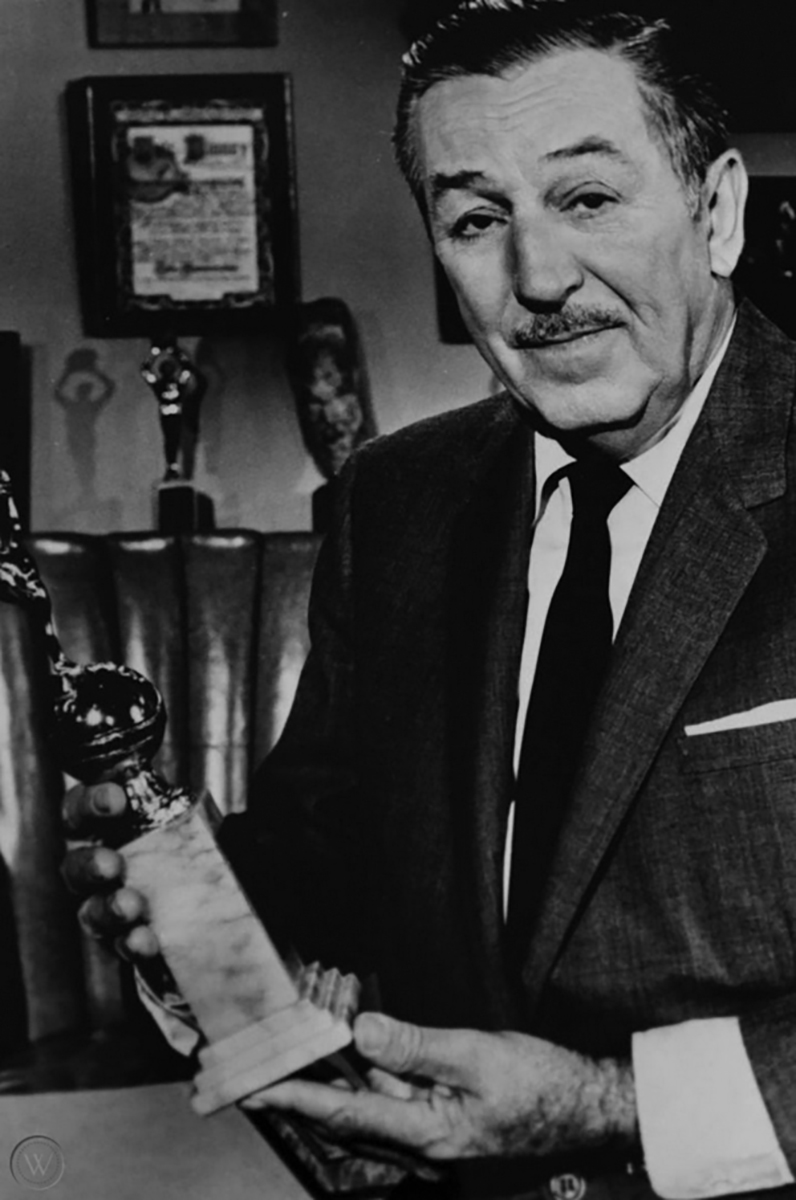
Ready for My deMille: Profiles in Excellence – Walt Disney, 1953
Beginning in 1952 when the Cecil B. DeMille Award was presented to its namesake visionary director, the Golden Globes has awarded its most prestigious prize 66 times. From Walt Disney to Bette Davis, Elizabeth Taylor to Steven Spielberg and 62 others, the DeMille has gone to luminaries – actors, directors, producers – who have left an indelible mark on Hollywood. Sometimes mistaken with a career achievement award, a Globes statute says the DeMille is more precisely bestowed for “outstanding contributions to the world of entertainment”. In this series, former Globes president Philip Berk profiles DeMille laureates through the years.
Say what you will about Walt Disney’s conservative politics, our second Cecil B. DeMille recipient, the first after DeMille himself, was a true visionary, one of the few true geniuses the industry has ever produced.
Ironically his only failing was his conservative fiscal philosophy. Others, like bankers, had more faith in his potential. If he had invested his own money in his two biggest gambles – the feature-length animated film and his amusement park, he would have died a far richer man, though not quite as rich as those who succeeded him. The crowning irony was that after his death, the studio, run by more adventuresome businessmen, became the most profitable, the most successful, the powerhouse studio that it is today.
Not that he didn’t believe in himself. His first jobs in animation brought him to Hollywood where, with his brother Roy and faithful animator Ub Iwerks, he established the Disney Brothers Studios. After releasing over 60 animated shorts, he found the key to his success when Steamboat Willie introduced Mickey Mouse to the world.
From 1932 to 1939 he won seven Best Short Subject (Cartoon) Oscars for his innovative achievements, which introduced synchronized sound, full-color three-strip Technicolor, and the multi-plane camera. Now, after producing over 300 shorts, he was ready for his big gamble, producing a full-length animated feature film, Snow White and the Seven Dwarfs, which his competitors dubbed Disney’s folly; it landed the company in hock before being rescued by Amadeo Giannini’s Bank of America. Of course, the film became a worldwide sensation, the most successful motion picture of 1938, and by May 1939 its total gross of $6.5 million made it the most successful sound film made to that date.
Encouraged by this success Disney embarked on two more features, including a collaboration with conductor Leopold Stokowski on Fantasia which utilized classical music as its inspiration.
Not surprising, the film was a hard sell, but his other animated feature, Pinocchio was the perfect follow up to Snow White. Unfortunately, World War II impacted its overseas box office, and it didn’t do as well.
It was his love for music that inspired Fantasia, and it was he who welcomed super-talented composers and lyricists to the studio. The songs they wrote for his classic animated features are among the greatest of all time, including Zip -a-Dee -Doo-dah and Chim Chim Che-ree as well as Someday My Prince Will Come, A Dream Is a Wish Your Heart Makes, You Can Fly, You Can Fly, When You Wish Upon a Star; the list is endless.
His 1941 animated feature Dumbo was less costly to make, and it returned its investment. But by now America was at war, and Black actor James Bassett a special honorary Oscar for playing Uncle Remus, but today it remains in limbo for perpetuating racial stereotypes. Another poorly received animated omnibus musical Melody Time suggested his halcyon days were over, so Disney turned to another hybrid So Dear to My Heart, which began his infatuation with family films about American frontier life which signaled his signing of teen actors in successive films. When their mediocre reception disappointed him, he turned to making documentaries, True Life Adventures as he called them, starting with Seal Island and culminating in the feature-length The Living Desert which captured one of three Academy Awards he received in one year and which was a box office hit.
Meanwhile, after a three-year interval, he unveiled Cinderella, one of his greatest triumphs and a worthy successor to Pinocchio and Snow White. The film became a worldwide box office hit, but it had been a costly undertaking, labor costs had skyrocketed and it had taken many years to produce. Alice in Wonderland which followed a year later met with some resistance, So now he decided to branch out into all live-action feature films, and using funds that had been frozen because of postwar austerity, particularly in the UK, he made Treasure Island with contract juvenile Bobby Driscoll and England’s venerable Robert Newton. It was a hit and he used that same formula on The Story of Robin Hood and His Merry Men, also a moneymaker.
Peter Pan his eighth animated feature was released the next year and although welcomed by audiences it was not as profitable as his live-action films so in quick order he delivered The Sword and the Rose and Rob Roy the Highland Rogue, both hugely profitable.
The Living Desert (1953) also merited a special Golden Globe “for artistic merit.” The next year his documentary The Vanishing Prairie also won an Oscar, and again a surprising box office hit.
A word of explanation as to why he wasn’t as prolific winning Golden Globes. At the time the Globes had no category for animation, but we made up for it in successive years when Mary Poppins was nominated for three Golden Globes and Julie Andrews won one.
Buoyed by all his true-life adventures success, he now returned to mainstream filmmaking hiring Kirk Douglas to star in 20,000 Leagues Under Sea. It was not the blockbuster he was hoping for, but he kept plugging away. His next animated feature Lady and the Tramp did okay, but motion picture attendance had fallen off and Hollywood was retrenching. Disney Studios was able to stay afloat thanks to its numerous television ventures, not the least of which was The Mickey Mouse Club. He became a beloved TV personality introducing a weekly show The Wonderful World of Disney on ABC, but now he was heavily involved in his dream project, the theme park Disneyland, which he got the TV network to invest in it.
He returned to filmmaking with Westward Ho, the Wagons!, Johnny Tremain, Old Yeller, and The Light in the Forest, all celebrating Americana, and all highly popular. A year later he unveiled Sleeping Beauty his least successful animated feature. But the year was saved by the surprise success of The Shaggy Dog and its many sequels, which began the studios’ long association with Fred MacMurray. These wholesome family films which later utilized his teenage protégés Kurt Russell and Hayley Mills were all highly popular.
One Hundred and One Dalmatians and The Sword in the Stone were well received and profitable, but what turned the studio around was the fulfillment of his life long ambition, to bring Mary Poppins to the screen. The film went on to become his biggest moneymaker and made Julie Andrews a huge star. Other hits followed but nothing to compare with the worldwide acceptance of Mary Poppins. Walt Disney continued to oversee the operation of the studio, but he left the running of the studio to his son-in-law. His main interest now was a new park, Epcot,
He lived to see the successful launch of his last animated film The Jungle Book (1967) but died before his dream of a second Disneyland, Disney World in Florida, opened in 1971. He would be gratified today, knowing the studio that still carries his name currently owns Marvel, Pixar, LucasFilms, and 20th Century Fox, to name but a few.