


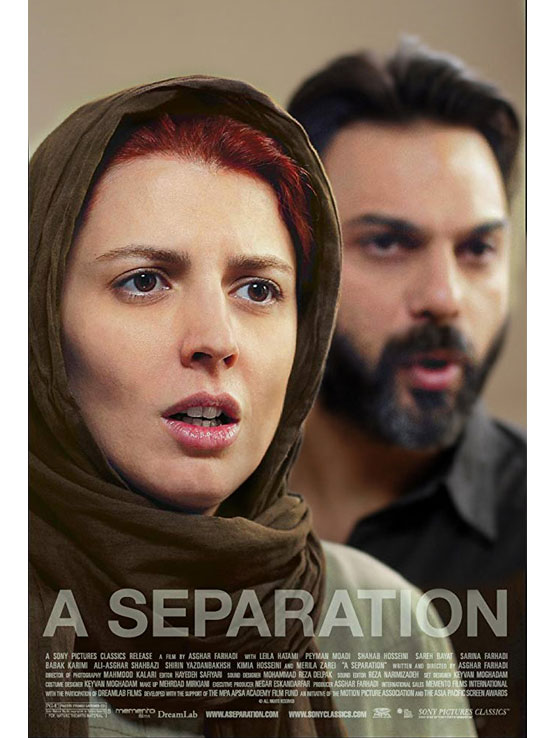
Asghar Farhadi Returns to Cannes And Celebrates 15th Anniversary of ‘A Separation’
Iranian filmmaker Asghar Farhadi will return to Cannes with his newest, Parallel Tales, which debuts at the fest and opens commercially in France this week.
This year also marks the 15th anniversary of his fifth film as director, A Separation, which proved to be his international breakthrough. After the earlier films had played in Iran, A Separation had its world debut at the 2011 Berlin film fest, then screened at festivals around the world, including Hong Kong, Buenos Aires, Sydney, New York, Abu Dhabi, and many others.
The release of A Separation struck a nerve in many countries and was certainly timely in Iran. The film appeared when Iranian society was still reeling from the aftermath of the Iranian Green Movement, which contested the 2009 election and was the biggest protest ever in the country. It was a climate saturated with distrust, anxiety, and deep social fractures. Although A Separation is not an overtly political film, it reflects the psycho-political condition of a society in which human relationships are put under strain.
At the core of the film lies a form of duality, which parallels the ideological divides of that period. This split manifests itself in interpersonal relations, in moral decisions, and in the uncertainties that shape the characters’ actions. The conflicts among Nader (Payman Maadi), Simin (Leila Hatami), and Razieh (Sareh Bayat) unfold in scenes where truth and falsehood, justice and expediency, faith and rationality become entangled and ultimately indistinguishable.
Writer-director Farhadi constructs a situation in which no party is entirely right or wrong; it is as if reality has fractured into multiple, irreconcilable parts. As Farhadi remarks in an interview with European TV station Arte: “In the film, I am speaking about forced migration; when you migrate, you sacrifice the past for the future—especially when there is no return. Simin is caught in such a situation. At the same time, the film’s perspective does not intend to side with any character or grant greater legitimacy to one over another.”
Within this framework, the urban middle class — represented by Nader and Simin — occupies a crucial position. This class, which had carried hope for change and improvement, is depicted in A Separation as trapped in a state of attrition and impasse. Simin’s desire to emigrate is not merely an individual choice but a sign of the erosion of hopeful horizons within this social stratum.
In contrast, Nader’s insistence on staying suggests a commitment to familial responsibility, and perhaps a form of resistance against disintegration. Their conflict reveals the paradox of the middle class: suspended between leaving and remaining.
At the same time, the encounter between this class and the lower class — embodied by Razieh and Hojjat (Shahab Hosseini) — exposes not only economic disparity but also cultural and ethical divides. Rather than fostering empathy, this encounter often leads to misunderstanding and the intensification of crisis. Ultimately, A Separation presents a portrait of a society in which crisis is reproduced at the most intimate levels of human interaction — a society in which every individual choice inevitably carries the weight of a collective condition.
The Golden Globes saluted it as the year’s best film not in the English language. Actor Hosseini noted to us at the time: “I have always been interested in roles that approach the boundaries of shared human experience — because that is where concepts become understandable to all people despite their differences. Poverty is one such shared boundary. There are people whose lives amount to nothing more than the cost of being alive — and beyond fate, the policies shaping life in our time often intensify these conditions.”
The crises in A Separation are evident even in its cinematography. The film is shot in a way that introduces controlled yet agitated movements — movements that convey the characters’ inner turbulence. Mahmoud Kalari, the film’s cinematographer, remarked to us at the 2012 Golden Globes: “My experience in photojournalism, having captured over a million frames, taught me how to situate events within their social context. As a result, the characters exist within frames that carry an anxious background, and the style of cinematography intensifies this. In fact, Farhadi approached me precisely because of my background in photojournalism and photography.”
Despite its roots in the social and political realities of Iran, A Separation also articulates fundamental tensions of the early 21st century — perhaps one of the reasons for its enduring relevance. These tensions are less strictly political than they are tied to crises of trust, the erosion of moral certainties, and the increasingly complex relationship between the individual and truth. In a world where grand narratives have lost their authority, individuals are compelled to make decisions in situations devoid of definitive answers.
A Separation operates precisely at this juncture: where truth is not singular but a network of conflicting narratives, and where every choice entails unpredictable consequences. For this reason, the film resonates far beyond its geographical origins.
A Separation can be regarded as one of the first Iranian films to achieve broad recognition in Europe and the United States without relying on an exoticizing gaze. The film neither distances itself from cultural specificity nor exaggerates local difference; instead, it focuses on an experience that is intensely modern and universally comprehensible: the crisis of the family. At the beginning of the new century, the family is no longer the stable and self-evident institution it once was. Economic pressures, geographic mobility, increasing individualism, and shifting social roles have transformed it into a site of tension and instability.
Simin’s decision to emigrate, Nader’s hesitation, and their daughter’s uncertainty all signal this gradual unraveling. Western audiences can identify with the characters’ situation without the need for cultural mediation: The issue is not simply Iran, but the fragile condition of living in the contemporary world.
One of the film’s most radical dimensions lies in its focus on judgment — not merely as a legal act, but as a perceptual, ethical, and even existential process. The viewer is placed in the position of a judge, while simultaneously being deprived of the means to judge. Each scene, each account, and each testimony reveals part of the truth while concealing another, leaving no stable ground from which to issue a definitive verdict. Judgment becomes an experience of perpetual uncertainty. In the film’s opening scene, for instance, the camera assumes the position of the judge, effectively aligning the viewer with that role. Yet by the end, the viewer comes to realize that human relationships are too complex to permit any final judgment.
Farhadi demonstrates that judgment, contrary to common belief, is never external or neutral; it is always entangled with our assumptions, fears, interests, and perceptual limitations. The judge in the courtroom, Nader, Razieh, and even the viewer are all subject to this condition: each attempts to construct a coherent narrative from incomplete knowledge. Thus, the film transforms judgment from a definitive act into a suspended state — one in which truth is neither fully revealed nor stabilized, but continuously deferred.
As Babak Karimi (who plays the judge) recounted to us at the Golden Globes: “During a rehearsal at a Tehran courthouse, I spoke with a real judge who told me: ‘Our job is quite futile. Our job is to issue verdicts according to the law — but do you think the problem is resolved once the verdict is carried out?” He described a man who, under severe economic and psychological pressure, had assaulted his wife and was now serving his sentence. “Do you think he will be transformed after prison?” the judge asked, then answered himself: “Certainly not — in fact, his condition will likely worsen. So, tell me, does our work truly achieve anything?”