


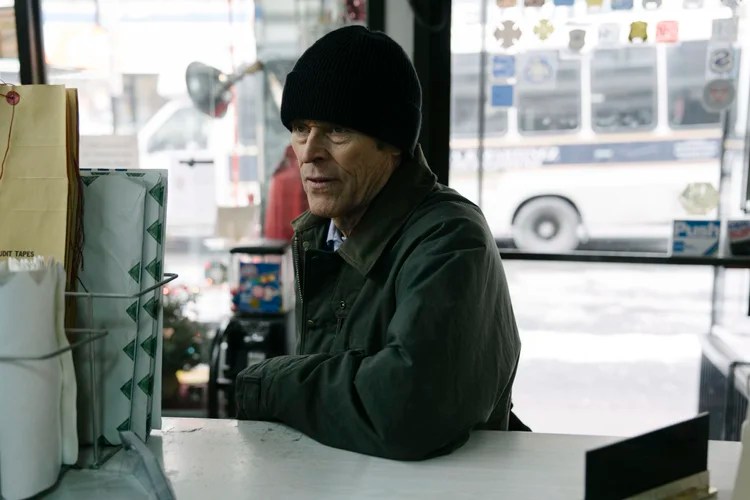
Willem Dafoe: A Life of Acclaim Channeled into ‘Late Fame’
The making of the film “Late Fame” sounds like something out of a movie itself. Written by Austrian author Arthur Schnitzler, the novella was written around 1910 and went unpublished for more than a hundred years, until 2014. The story centers on a forgotten poet, Saxberger, whose work is discovered by a young fan whose attention and flattery reawaken a longing for a past time.
Willem Dafoe was drawn to the story when it was recommended by his friend, actor-writer Daniel Zippi. “He told me from the start, ‘I think this is a movie,’” recalls Dafoe. “I read it and immediately thought, ‘Absolutely.’ And I began carrying it around with me, contemplating finding out who had the rights to it.”
In fact, the book was in his knapsack when he boarded a flight from New York to Los Angeles and found himself bumping into filmmaker Kent Jones (“Diane”), whom he was acquainted with through the New York Film Festival. “We talked about everything under the sun, so many things,” Dafoe reveals. “But not once did we talk about ‘Late Fame.’” Two days later, Jones called the actor. “He said, ‘Listen, I’ve got this project called “Late Fame” and I’d like you to do it. I’ll send you the script.”
Magnolia Pictures is distributing the film in the U.S., with a commercial release in August that follows multiple slots on the awards circuit.
Adapted by Samy Burch, the script updates the story to modern day New York City. Saxberger is a postal employee and his admirer arrives in the form of the charming Meyers (Obie Award winner Edmund Donovan). Meyers welcomes the artist into his collective, The Enthusiasm Society, where the members’ hero worship is challenging to resist.
While Dafoe certainly isn’t Saxberger — the four-time Oscar nominee has spent the last 40 years as one of our busiest and most acclaimed actors – he related to many elements in the story. “It’s very much a New York story, which is where I was formed as an actor,” he notes.
There’s a nostalgia for the mid-’70s New York downtown scene, and the characters keep asking Saxberger what that time was like. “There was a meta aspect because to some degree, that happens in my real life,” Dafoe says. “People ask me about the early days or pump you for stories about that time. And when people pay attention and request that information, you can start to get puffed up and try to become the person they want you to be. It really put me in touch with the kind of seduction where you start to adjust yourself to satisfy what other people want you to be.”
Indeed, it’s not hard to imagine the actors playing members of the collective had to work hard to do scenes where they’re in awe of Dafoe. “It was very easy,” Donovan admits of playing Meyers’ hero worship. “But Willem puts you at ease almost immediately.”
Dafoe says “I learn so much from these young actors I get to work with” and compares Donovan to a former co-star. “He reminded me a bit of when I worked with Christian Bale on ‘American Psycho’ in how he was so prepared and so wound up, yet so flexible,” raves Dafoe. “He was ahead of his game and prepared but loose — way ahead of his game. They have that in common.”
Dafoe could also relate to acknowledging the passing of time and how things have changed. At one point, Saxberger says, “I used to be the youngest one in every room, and now I’m the oldest.” It was actually a line Dafoe has used in an interview. “I remembered saying that and I found that feeling creeping up on me so many times in the movie,” he reveals. “I said, ‘We’ve got to put it in there somewhere, because it really expresses this moment in life.’”
Saxberger soon finds himself unable to write a new poem — whether out of writer’s block or fear or the moment having passed. But Dafoe shows no signs of slowing down – the actor has several movies set to release in the coming months. This includes “Tenzing,” about the first man to climb Mt. Everest and a role in “Werwulf,” which reunites him with Robert Eggers, his director on “The Lighthouse” and “Nosferatu.” He also recently completed “Time Out” with Adam Sandler and shot “White Lies” with Oliver Stone. It was Stone who launched Dafoe’s film career with 1986’s “Platoon,” but the pair haven’t teamed since 1989’s “Born on the Fourth of July.”
Dafoe is a frequent return player of directors – Wes Anderson, Paul Schrader and Lars Von Trier are just some of the filmmakers who regularly come calling. “I’m very drawn to people who are world makers, who have a specific vision and whose stories I can really serve,” he notes. He compares it to the tradition of theater; Dafoe spent 27 years with the groundbreaking company The Wooster Group. “There’s a strength to working with the same people. You mature with them, you get to know them and you can give each other challenges that maybe someone who just met you couldn’t.”
But he also loves working with new directors and talent. “There are so many exciting voices emerging every day,” he notes. “And I love to roll the dice.”