


‘Lesser God,’ Now 40, Still Sets Standard for Disability Depiction in Hollywood
Disabled representation in movies has a fraught history. Stray movies that have authentic representation often become the poster child and thus must represent every disability. Children of a Lesser God is a prime example. Upon release on October 3, (1986, it broke barriers for how deaf and disabled individuals could be portrayed in film, specifically women. Based on the 1979 stageplay by Mark Medoff, the film follows teacher James Leeds (William Hurt) as he takes a new position teaching the deaf at a New England school. He soon meets the school’s janitor, Sarah (Marlee Matlin) and the two embark on a romance that changes each of them in different ways.
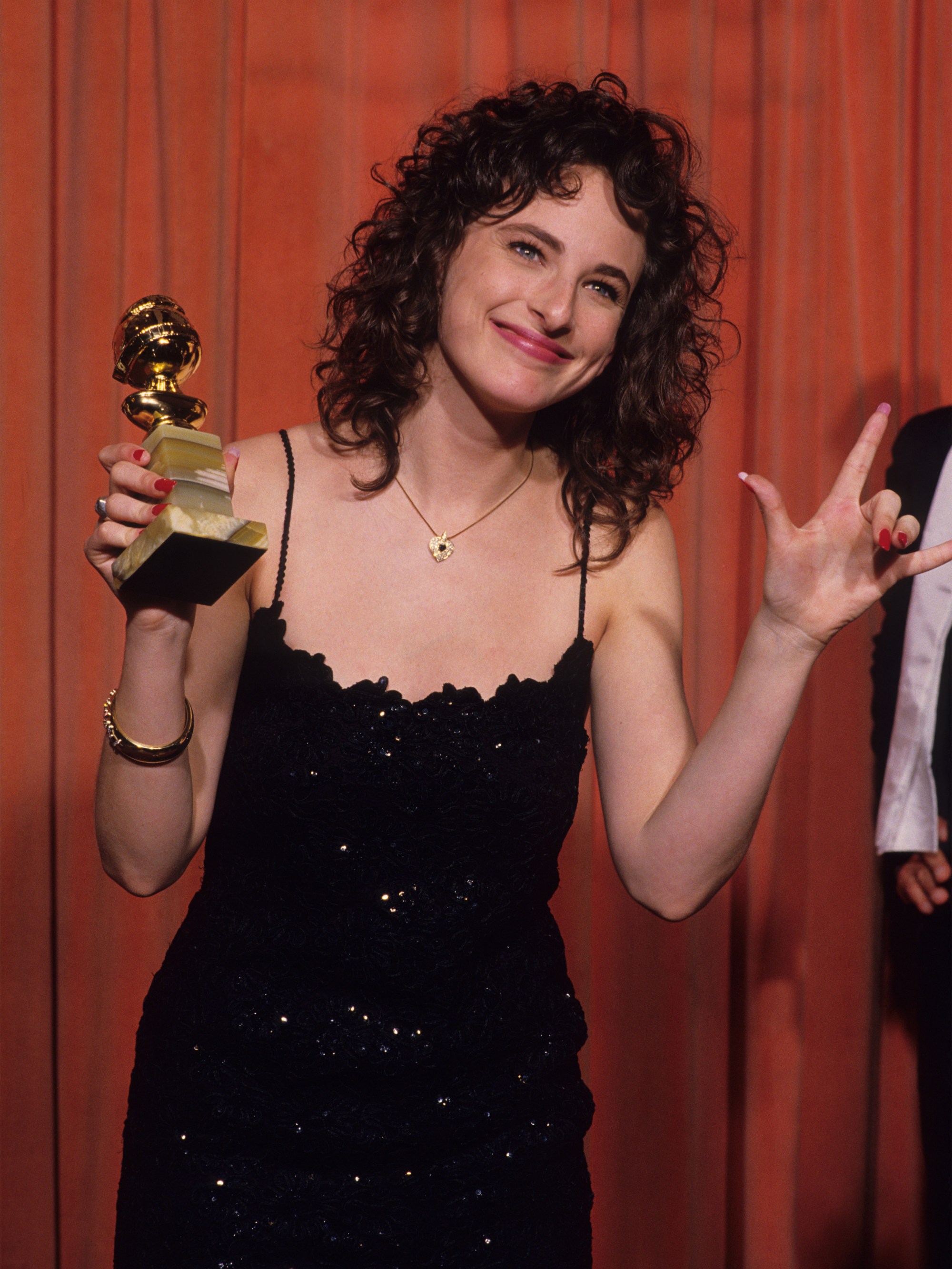
“I still feel 19-years-old,” Matlin tells the Golden Globes when asked about the movie entering its 40th anniversary. It’s amazing to think that Matlin was just nineteen when she made the movie, twenty when she secured the Oscar nomination for Best Actress, and twenty-one when she won the award. That Oscar made Matlin the first Deaf performer to ever win an Oscar and, at the time, that significance was something she wasn’t really focused on.
“When I did Children of a Lesser God, I had no idea while making the film about the importance of representation,” she said. “I had no idea that this was the first film with a Deaf leading actor. I wasn’t told. I wasn’t in the know about deaf actors dying to be in the mainstream, or trying to get into Hollywood, or even to get noticed in television and film. All I knew and cared about was that I was cast to star in a leading role in a film at the time, and that was the nature of my being so young, of being naive.”
For Matlin, the experience filming the movie also wasn’t fraught with the usual elements actors with disabilities usually discuss. Matlin had her own interpreter on set at all times, as did all the actors who played the various students at the school. Hurt also had his own ASL teacher to aid him in communication with the performers. The filmmaking team, including director Randa Haines, also learned how to sign during production.
It is Haines, in particular, that Matlin shouts out as challenging her as a performer and not treating her with kid gloves.. “Randa worked her ass off,” Matlin said. “It was not easy for her to work with William Hurt, but she loved working on films. She believed in this film, and she wanted it to be perfect. She was an actor’s director, if you want to call her that. She listened. She communicated with me. She worked me hard … She was honest. She really cared a great deal for me as a director.”
The cast rehearsed for three weeks prior to the filming which Matlin describes as “intense,” and that commitment didn’t dissipate once cameras started rolling.
“I still think she did the most takes of any director that I’ve ever worked with,” Matlin said. “Fifteen, sixteen, seventeen, eighteen takes. She scrutinized my psyche. She wasn’t shy to tell me or direct me. She could see right through the camera, right into my soul, and at the same time, she had to train me too because I was new. But I put all my trust into her, and I took her direction very well.”
One of the challenging scenes that Matlin struggled with involved Sarah’s penchant for swimming. Those scenes were a three-day process filming in 90-degree water while having “the worst fights” with her co-star, and boyfriend at the time, actor William Hurt. One swimming shot saw her enter the pool in the nude.
“I had to dive over the camera,” she said. “The camera was underneath in the water, and I was stark naked filming that scene. I did five takes, and then after the five takes, the director of photography [John Seale] came up to me very discreetly and said, ‘You did a beautiful take each time, jumping over the camera into the water, swimming forward. Would you mind the next time you jump in to keep your legs together?’ And I’m thinking, ‘Okay, where is that film now? I hope it’s in some film vault or it’s been burned.'”
Matlin hurtled into stardom upon the movie’s release, something she called “a trial by fire.” At the same time, she was dealing with a long-term addiction to drugs, as well as being in a toxic and abusive relationship with Hurt. “The night before I went to rehab I won the Golden Globe,” she said. The awards love is bittersweet, particularly as Matlin has described in her autobiography, I’ll Scream Later, how Hurt denigrated her Oscar win, questioning whether she truly deserved it for her first role.
Since then, Matlin has revisited Children of a Lesser God and understands its significance to deaf and disabled audiences. “There’s always a first for everything and then you move on, and then we have CODA [which went on to win Best Picture at the Oscars], and that worked. Unfortunately, it took 35 years between Children of a Lesser God and Coda. I’m still waiting for another one to come along.”
Regardless of how long it takes another disability-centric film to return to theaters (actually, November with Being Heumann), Matlin remains a foundational part of disability representation in the movies with a performance that’s just as fresh and vibrant as it was forty years ago.