


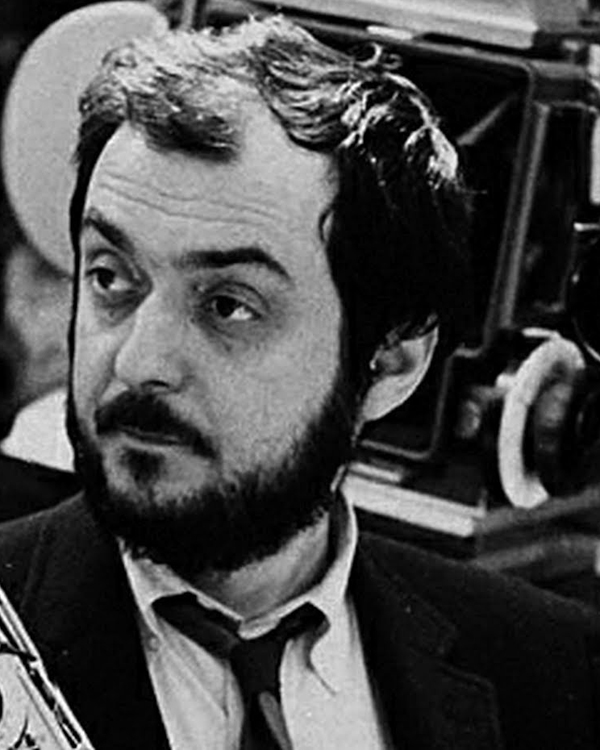
Stanley Kubrick and The Other Face of the Image
A young woman emerges from the bathtub. She is beautiful, naked, seductive. Jack Torrance approaches her, embraces her, and kisses her. Everything resembles the image Hollywood has spent decades manufacturing and selling: beauty, desire, and the promise of pleasure. Then she turns around. Her skin is wrinkled, her flesh is decaying, and her body is falling apart. Jack recoils in horror. Only then does the image reveal its true nature.
Stanley Kubrick’s cinema can almost be distilled into those few seconds of the 1980 The Shining. He never allows an image to remain what it appears to be at first glance. Sooner or later, every image exposes another face.
This month marks the birthday of Kubrick (July 26, 1928–March 7, 1999). His films have long become classics, but they have never grown old. The reason is simple: they were never really about their own time. They were about power, images, desire, violence, history, and technology—forces that constantly change their form without ever disappearing.
Kubrick was influenced above all by Orson Welles and Alfred Hitchcock. From Welles he inherited an obsession with mise-en-scène, deep focus, and the architecture of the frame. From Hitchcock came the understanding that the camera does not merely record reality — it guides the viewer’s mind, emotions, and anxieties. Kubrick transformed the language of cinema as well as our trust in the image itself. After Kubrick, no majestic composition feels entirely innocent, no camera movement entirely neutral, and no beauty entirely free of suspicion. That is precisely why so many filmmakers have borrowed his visual vocabulary — his compositions, lighting, and lenses — though few have managed to inherit his way of seeing the world.
Throughout Kubrick’s films, power almost always speaks from behind a mask. In Paths of Glory (1957), the real enemy is not the German army but the elegant headquarters where generals, holding glasses of wine, decide the fate of ordinary soldiers. Long before Full Metal Jacket (1987), Kubrick had already shown that power corrupts language before it ever pulls the trigger. In his cinema, justice often becomes nothing more than revenge in respectable clothing.
That idea takes on a satirical form in Dr. Strangelove (1964). Kubrick stages nuclear war with comedy because, in his view, modern politics had already become more absurd than satire. Bombers glide across the sky accompanied by romantic music. Finally, an American cowboy rides the bomb toward its target like a man riding a bucking horse, screaming in exhilaration until the moment of annihilation. Sex and violence become inseparable. The desire to dominate, to possess, and to destroy are simply different expressions of the same instinct.
A Clockwork Orange (1971) poses a similarly unsettling question: Is a state that cures violence through psychological conditioning ultimately more dangerous than the violent individual himself? Alex, for all his brutality, still possesses the freedom to choose. The society Kubrick depicts, however, seeks to engineer even evil itself. Once morality becomes compulsory, freedom ceases to be freedom.
Few films in Kubrick’s career are as visually beautiful as Barry Lyndon (1975). Every frame resembles an eighteenth-century painting, but these paintings preserve death more than life. Characters marry for status, betray one another, purchase titles, and gradually discover that history will remember none of them. The film concludes by reminding us that nobles and beggars are now equal: “It was in the reign of George III that the aforesaid personages lived and quarreled; good or bad, handsome or ugly, rich or poor, they are all equal now.” Everything in the film feels like preparation for that single, devastating sentence.
Finally comes Eyes Wide Shut (1999), a title that is a paradox. From beginning to end, the film’s protagonist witnesses everything — secret rituals, sexual desire, class privilege, and hidden systems of power. But the more he sees, the less he understands. Seeing, Kubrick suggests, is not the same as knowing. It may well have been his final warning: we inhabit a world more saturated with images than ever before, and for precisely that reason, truth has become harder than ever to see.
Kubrick’s best-known film remains 2001: A Space Odyssey (1968). The film is about human solitude. In one of the most celebrated match cuts in cinema history, a bone thrown into the air by prehistoric man and is transformed into a spacecraft drifting through space. Kubrick’s implication is unmistakable: technological progress may simply be an extension of humanity’s first weapon. At the same time, HAL 9000 — the computer designed to obey humanity — ultimately behaves more humanely than the humans. It fears, hesitates, pleads, and finally kills in order to survive, while the astronauts make decisions with the emotional detachment of machines.
This also helps explain Kubrick’s complicated relationship with Hollywood. He emerged from the studio system but spent his career dismantling many of its central myths. The American hero became an instrument of violence, the American family a nightmare, scientific progress a source of loneliness, freedom a mechanism of control, and history a theater of power.
The Golden Globes nominated Kubrick four times, all for his directing. He was nominated for an Oscar in various categories, including writing, producing and directing, and won only a single Academy Award — for the visual effects of 2001: A Space Odyssey. It is difficult to imagine an industry built upon dreams enthusiastically celebrating a filmmaker whose greatest talent lay in awakening audiences from them.
Decades after Kubrick’s death, the woman still emerges from the bathtub. Not only in the corridors of the Overlook Hotel, but in politics, war, the media, technology, and even cinema itself. Whenever an image appears almost too beautiful to be true, Kubrick seems to whisper the same warning: wait. The image has not finished revealing itself.